

Call answering: why Alexander Graham Bell would have benefitted from call answering and more…
This blog focusses on three pioneers, and one or two also-rans, whose inventions and tenacity paved the way for modern telecommunications and, consequently, a whole industry focussed on call answering.
Phone, switchboard and handset
The inventions are the phone, the switchboard and the telephone handset. The most amazing aspect of these three inventions? They all occurred before 1880!
Call answering pioneer no 1: Alexander Graham Bell
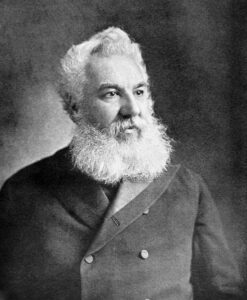 On March 7th 1876, Alexander Graham Bell was granted a patent covering the method of, and apparatus for, transmitting vocal or other sounds telegraphically by causing electrical undulations, similar in form to the vibrations of the air accompanying the said vocal or other sounds.
Bell is a fascinating character. Born in Edinburgh in 1847, his family moved to Canada in 1870 and the following year he settled in Boston, USA. He had a longstanding interest in sound technology as both his mother and wife were deaf and in 1872 he opened the ‘School of Vocal Physiology and Mechanics of Speech’ which taught speaking skills to deaf students (one of whom became his wife). Although he had few formal qualifications, by the age of 26 Bell had been appointed Professor of Vocal Physiology and Elocution at Boston University.
Other claimants to the epithet ‘call answering pioneer’.
As with many inventions, there are several other candidates who could claim to be a call answering pioneer by inventing the phone: Charles Page, Innocenzo Manzetti, Charles Bourseul and Johann Reis were all involved in some aspect of telephone-related innovation before Bell was awarded his patent. However, Antonio Meucci has probably the strongest claim to having beaten Bell to the line.
Meucci was born in Italy and moved to New York later in life. In 1871 he submitted his first US patent application. More accurately, he posted a caveat which was, effectively, an announcement of his invention (rather like ‘patent-pending’ in the UK). Far from wealthy, Meucci was unable to find the funds to renew the caveat in 1875. A claim against Bell by Globe Telephone, the owners of Meucci’s intellectual property, went on for 12 years until 1897, eight years after Meucci’s death!
Bell Telephone Co
Bell Telephone Co was launched in 1877 by Bell and his longstanding assistant Thomas Watson. Watson was not only the recipient of the first-ever phone call, but he was also the recipient of the first transcontinental phone in 1915. Bell made the call in New York and Watson ‘picked up’ in San Francisco.
The first call answering services prospect?
Not only was Bell a call answering pioneer, but he was also the first potential customer for call answering services. Bell refused, by all accounts, to have a telephone in his study as he feared it would distract him from his scientific work. Unfortunately for Bell, Paperclip’s call answering services wouldn’t become available until 2007!
Pioneer no 2: George Coy
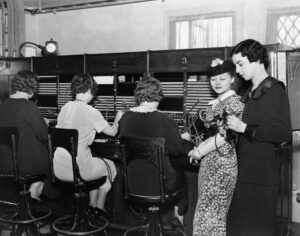 Telephone exchanges and switchboards are precursors to today’s call answering services.
The idea of a telephone exchange was first floated in 1876 – the same year that Bell received his patent – by a Hungarian engineer, Tivadar Puskas. Puskas was working on a telegraph exchange for another renowned inventor, Thomas Edison when he came up with the concept of a telephone exchange.
The award of call answering pioneer, however, goes to George Coy. The first commercial telephone exchange was built in 1878 and, as part of this development, Coy built the first-ever switchboard. It was claimed that the switchboard was constructed of ‘carriage bolts, handles from teapot lids, and bustle wire’! The switchboard could connect 64 customers but only two conversations could be handled simultaneously.
Coy was one of the Directors of the New Haven District Telephone Co which owned a franchise from Bell Telephone for providing phone services in its region. New Haven launched with 21 subscribers. By the time it published its first directory in 1878, the number of subscribers had increased to 50!
Pioneer no 3: Cyrille Duquet
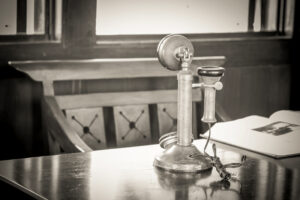 The earliest phones consisted of separate transmitters (mouthpieces) and receivers (earpieces): witness the phones in early black and white movies.
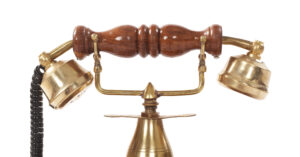 Duquet was a Canadian inventor, who initially worked in the field of clocks and watches. He was awarded a Canadian patent for a telephone receiver and then worked on combining the transmitter and receiver in one unit: the forerunner of the modern handset.
Duquet’s involvement with telephone innovation was short-lived. He sold his patent for $2,100 and, as part of the agreement, waived the right to undertake any further work in the field of telephony. Duquet’s original phone still exists and is displayed at Bell Canada.
Bell, Coy and Duquet: are just three of the many pioneers whose inventions have led to today’s call answering services.
Would you like to work undisturbed like Alexander Graham Bell?
If you would like to work undisturbed like Bell, want to ensure your business captures all its sales opportunities, or meet some other business challenge then Paperclip’s telephone answering services may be the answer. We serve businesses in many sectors. Solicitors, for example, one read our article about Law firm Call Answering.
Contact Paperclip to find out how call answering can help your business
Find out more about our call answering services and more, visit www.paperclip.co.uk or call me on 01246 418181. Your call will be answered!

Hi, I’m Anne Batty, Managing Director of Paperclip. I am passionate about customer service. I believe enduring relationships are built on being open, transparent and trustworthy.
I love questions. So, if you have a question relating to telephone answering – pricing, technical, scope and more – I would love to hear from you at anne@paperclip.co.uk or 01246 418181.
Paperclip’s clients enjoy working with us. I know you will too.