Professional call answering services for UK based businesses big or small.

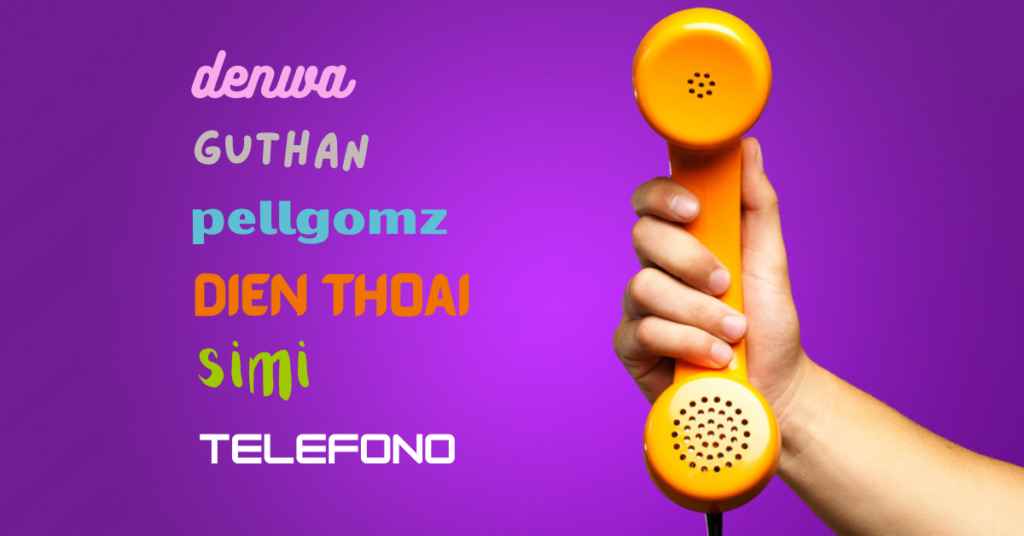
A telephone by any other name…

You say telephone, I say guthán

The invention of the telephone is attributed to Alexander Graham Bell, a Scottish-born Canadian-American scientist and inventor. As well as the telephone, Bell is also credited with inventing the metal detector and the aileron, the hinged flap on an aeroplane’s wing that controls roll.

Several other inventors made significant developments that enabled Bell to patent his telephone in 1876. An Italian, Antonio Meucci, developed a voice-communication device in the 1840s but did not patent it. The US Congress recognised Meucci as the inventor of the telephone in 2002.  Elisha Gray, who is considered to be the father of the music synthesizer, lodged a patent for a telephone on the same day as Bell, but Bell’s patent was the one that was upheld.

The word ‘telephone’ predated Bell’s patent and is attributed to a German scientist, Johann Philipp Reiss, in around 1860. Telephone is formed from two Greek words, ‘tele’ meaning far, and ‘phone’ meaning voice or sound. The literal translation of telephone is, therefore, distant voice.

Today, whilst the spelling may vary slightly and incorporate diacritics (the posh word for accents above or below a letter) of one sort or another, ‘telephone’ is recognisable in many languages, particularly those in Western Europe.

For example:

French – téléphone

Spanish – teléfono

Italian – telefono

Portuguese – telefone

German – Telefon

Dutch – telefoon

Polish – telefon

Turkish – telefon

Welsh – teleffon

‘Distant or far voice’ is also the basis for the translation of telephone in several of the languages of India, including Hindi, Marathi, Kannada and Tamil:

Hindu/Marathi – टेलीफ़ोन (durbhas)

Tamil – தொலைபேசி (tolaipeci)

Please note – some of the diacritics are not readily available in the Microsoft Word symbol set.

Using ‘distant voice’ as the basis for telephone is, however, far from universal. In many oriental languages, such as Mandarin, Japanese, Korean and Vietnamese, the word for telephone translates as ‘electric speech’:

Mandarin – 电话 (diànhuà)

Japanese – 電話 (denwa)

Vietnamese – điện thoại

Several languages, including Icelandic, Swahili, Hausa (a language spoken in Nigeria, Niger and other West African countries), and Mongolian, use a word meaning ‘cord/thread/wire’ to refer to the telephone:

Icelandic – sími

Hausa – waya

Swahili – simu

Mongolian – utas

There are several language outliers that don’t use ‘distant voice’, ‘electric speech’ or ‘wire’ as the basis for their version of telephone. In Irish Gaelic, guthán is one of the translations (teileafón is the other) and means ‘little voice’. The Finnish for telephone is puhelin, which is derived from words meaning ‘talk’ and ‘tool’ (or, alternatively, ‘to chatter’).

Our favourite translation, however, is from Arabic where a telephone is هاتف (hatif) literally meaning ‘mysterious voice’.

Louise Bellwood Profile Photo

Hi, I’m Louise Bellwood, Director at Paperclip. I am responsible for delivering Paperclip’s customer service and growth strategies for 2024 and beyond,  I am a crusader for the benefits call answering can deliver for organisations of all kinds; customer service, sales generation, customer retention and more. If you have a question about call answering – pricing, set-up, benefits – I would love to hear from you at louise@paperclip.co.uk or 01246 418 181.

Book

T 01246 418 181

Webchat: Click on here to chat to a member of our team.

E info@paperclip.co.uk

Or alternatively please use the form below to send us a message and we will get back to you as soon as possible.